
If you own a home in Pasco, Pinellas, or Hernando County, an air-cooled HVAC system is usually the better pick. It uses little to no on-site water, costs less up front, and handles Florida heat and humidity well.
Here’s the short version:
- Standard air-cooled systems use almost no potable water on-site
- Water-cooled systems can use 150 gallons per day or more in summer, and large setups may use thousands of gallons per day
- Water-cooled equipment can use 20% to 50% less electricity per ton
- But it also brings higher install cost, water treatment, and more service work
- For most homes, a high-SEER2 air-cooled system or variable-speed heat pump makes more sense
- For large buildings, water-cooled systems may cut long-term power costs enough to justify the added parts and water use
The main tradeoff is simple: lower power use on one side, higher water use and more system work on the other.
Air-Cooled vs Water-Cooled Chillers and how they work with Air Handling Units
sbb-itb-ab7d5a1
Quick Comparison
| What to compare | Standard air-cooled system | Water-efficient water-cooled system |
|---|---|---|
| On-site water use | Little to none | High, even with recirculation |
| Power use | Higher | Lower |
| Upfront cost | Lower | Higher |
| Service needs | Lower | Higher |
| Best fit | Homes, small spaces | Large commercial buildings |
| Florida humidity fit | Good | Often a weak fit for homes |
I’d sum it up this way: if you’re cooling a house, I’d look first at proper sizing, duct design, SEER2 rating, and humidity control. Those factors often matter more than chasing a water-based setup. If you’re dealing with a large property, then the power savings from water-cooled equipment may be worth a close look.
How Each System Type Uses Water
Water Use in Standard Residential HVAC Systems
Standard residential HVAC systems use little to no potable water during normal operation. They get rid of heat through refrigerant and outdoor airflow, not through a water supply. The main water output is condensate - moisture pulled from indoor air during dehumidification. That moisture drains out through a condensate line, so it’s not water the system takes from your home’s supply.
During hot, humid summer weather, a typical central AC can produce 5–20 gallons of condensate per day when it’s running hard. So if you’re looking at water impact, the bigger issue usually isn’t direct use inside the equipment. It’s the indirect water tied to the electricity the system uses. That’s why water-based cooling setups are the main comparison point.
How Water-Efficient Designs Cut Water Waste
Water use goes up when a system depends on evaporation or cooling towers to dump heat. Systems that cut water waste usually do it in three main ways.
- Closed-loop systems reuse water instead of sending it out after one pass. They recover about 95% of total water, with only around 5% lost through evaporation and blowdown.
- Indirect evaporative cooling (IEC) moves heat through a heat exchanger, so the supply air never touches the water. That helps trim water use compared with direct evaporative cooling.
- Condensate recovery collects the roughly 0.5 gallon of condensate per hour that a two-ton AC unit can produce. That water can then go to irrigation or other non-potable uses where local codes allow. In places where it’s permitted, captured condensate can help offset irrigation demand.
Lower water demand often lines up with lower operating energy, which sets up the next comparison.
Energy Performance and Operating Efficiency
How Standard Systems Perform on Electricity Use
In Florida, cooling often makes up 40–50% of a home's yearly electricity use. That's a huge slice of the bill.
Here's where most of that power goes: the system moves heat through a refrigeration cycle, and the compressor does most of the electrical work. After that, the outdoor fan and indoor blower account for much of the rest.
Homeowners usually compare equipment with two ratings:
- SEER2 measures seasonal efficiency across a full cooling season
- EER2 measures efficiency at peak conditions: 95 °F outdoors, 80 °F indoors, and 50% humidity
Higher ratings mean lower electricity use. Moving from an older 10–12 SEER unit to a newer high-SEER2 heat pump can cut cooling energy by 20–40%, depending on the house and how the system runs. But there's a catch: ratings on paper only go so far. If the install is off, the system may never hit those numbers in day-to-day use.
Ductwork is a big part of that. Poor duct layout, undersized return ducts, or high static pressure can make the blower work harder than it should. That can lead to coil icing, weak moisture removal, and longer run times. Good practice aims for about 350–450 CFM per ton of cooling, with static pressure kept within the manufacturer's allowed range. In West Florida, that matters even more because humidity can keep systems running for long stretches.
Florida's humidity also shifts more of the burden to moisture removal, which pushes up runtime and electricity use. Oversized systems are a common problem. A Florida Power & Light and Florida Solar Energy Center study covering more than 350 homes found that about 50% of residential AC systems were oversized by 120% or more. Those oversized systems used about 3.7% more energy per year than properly sized systems and also left homes feeling damp.
How Water-Efficient Designs Can Lower Energy Use
Water-cooled systems can use less electricity because they dump heat more efficiently than air-cooled units. A water-cooled chiller rejects heat more efficiently than an air-cooled unit because it operates against the wet-bulb temperature rather than the dry-bulb. In plain terms, it has an easier path for getting rid of heat.
That difference shows up in power use. Water-cooled chiller systems often run at about 0.85 kW/ton, while air-cooled systems are closer to 1.5 kW/ton. Even after adding the power used by pumps and cooling towers, total electricity use can still be 20–37% lower.
Controls can cut usage even more. Smart thermostats, variable-speed pumps, and load-matching controls help the system avoid using more power than the building needs at a given moment.
For most single-family homes in Pasco, Pinellas, or Hernando County, the most practical way to cut power bills is still a properly sized, high-SEER2 heat pump with a smart thermostat. Water-cooled setups tend to make more sense in larger buildings or multi-unit properties because of their added cost and system complexity.
No matter which system is used, the same basics decide how it will run in the field: Manual J load calculations for sizing, sealed and balanced ductwork, and controls set up the right way. Without those pieces in place, even a high-rated system can waste energy all season.
These efficiency gaps feed straight into the lifetime cost comparison next.
Direct Comparison: Water Use, Energy Use, and Long-Term Cost
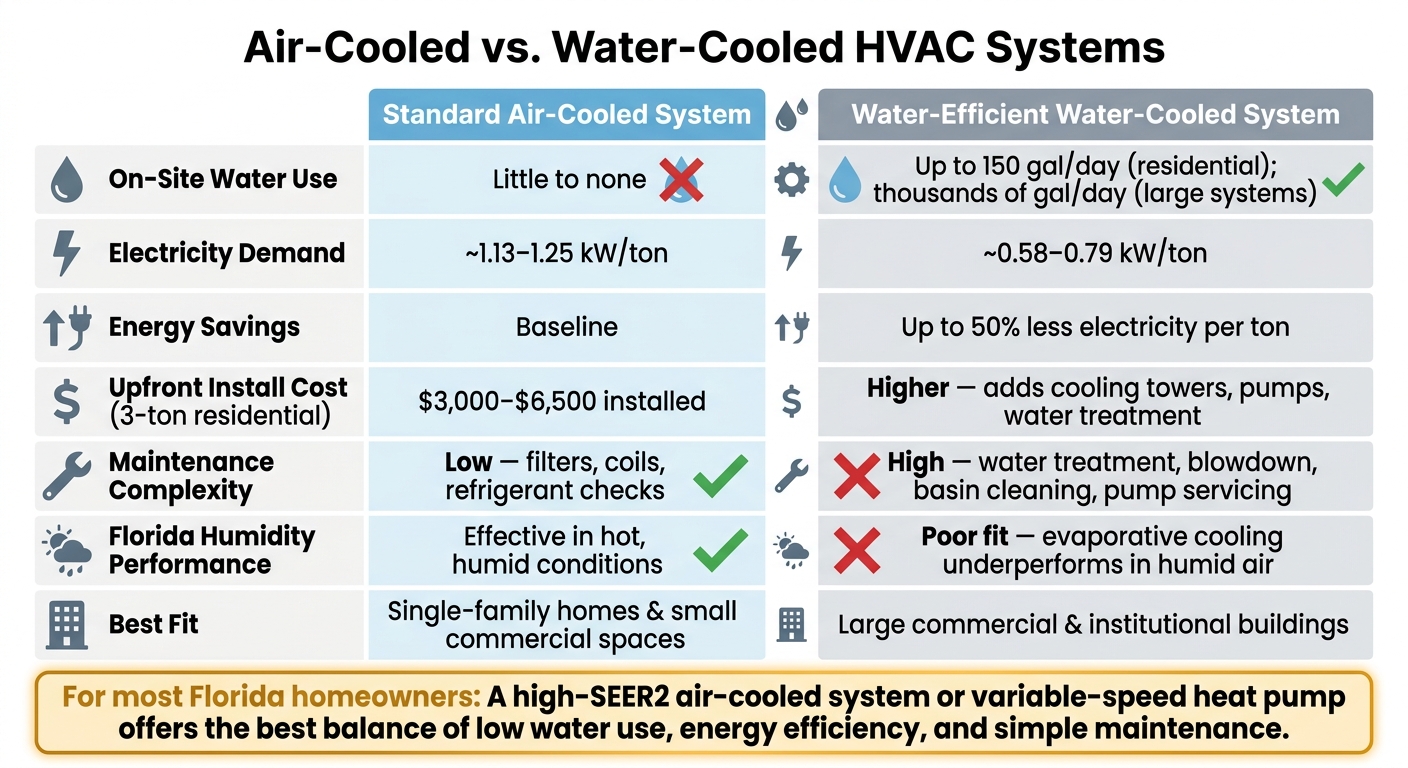
Air-Cooled vs. Water-Cooled HVAC: Key Metrics Compared
Side-by-Side Comparison Table
The tradeoff is pretty clear once you put the numbers next to each other. Water-cooled systems are the best comparison for this topic because they show the most direct on-site water use during normal operation.
At that point, the main question becomes simple: do the water savings on one side outweigh the added cost and system complexity on the other?
| Metric | Standard Air-Cooled System | Water-Efficient Water-Cooled System |
|---|---|---|
| On-site water use | No direct on-site water use during normal operation | Significant direct on-site water use; a typical 2,000 sq ft evaporative cooler can use about 150 gallons/day in summer, and larger cooling-tower systems can use thousands of gallons/day |
| Electricity demand | ~1.13–1.25 kW/ton | ~0.58–0.79 kW/ton |
| Energy savings vs. air-cooled | Baseline | Up to about 50% less electricity per ton of cooling |
| Maintenance complexity | Low to moderate: filters, coils, refrigerant checks | High: water treatment, blowdown, tower cleaning, pump and valve servicing |
| Best fit | Single-family homes and small commercial spaces | Larger commercial and institutional buildings with central plants |
Upfront Price vs. Lifetime Cost
Once you see the operating differences, the next step is cost. Not just the sticker price, but what the system will cost over time.
Standard air-cooled residential systems usually cost less to install because the setup is simpler. You need refrigerant piping, ductwork, and electrical connections, but not cooling towers, pumps, or water-treatment equipment. In the U.S., a typical 3-ton central AC usually costs about $3,000 to $6,500 installed, while a 4-ton unit usually falls between $3,500 and $7,500. High-efficiency models rated at 18+ SEER2 can run about $3,500 to $5,000 per ton installed.
Water-cooled central systems cost more upfront. The added price comes from cooling towers, pumps, water-treatment systems, and more involved commissioning. Where these systems can win is on long-term power use. In larger buildings, they can cut electricity use by roughly 30% to 60% compared with air-cooled equipment. But there’s a catch: at that same scale, makeup water can become a major operating expense. That’s one big reason these systems make sense for large buildings, not homes.
For most Florida homeowners, the lifetime-cost question is more straightforward. Moving up to a high-SEER2 air-cooled system can cut cooling energy use by 20% to 40%, with payback periods of about 6 to 9 years in central and south Florida.
Pros and Cons Table for Each System Type
In Florida, humidity changes the equation. A system can look good on paper and still be a poor fit once the weather kicks in.
| Factor | Standard Air-Cooled | Water-Efficient Water-Cooled |
|---|---|---|
| Installation complexity | ✅ Straightforward; no tower or pump loop | ❌ Complex; requires tower, pumps, and water treatment |
| Maintenance | ✅ Simple; filters, coils, refrigerant checks | ❌ Ongoing water treatment, blowdown, basin cleaning |
| Florida humidity performance | ✅ Effective in hot, humid conditions | ❌ Evaporative cooling performs poorly in humid air |
Which Option Fits West Florida Properties
For most homes in Pasco, Pinellas, and Hernando County, high-SEER2 air-cooled systems are the practical fit. They avoid direct on-site water use, work well in Florida humidity, and keep maintenance more manageable.
Water-cooled central systems make more sense in large commercial or institutional buildings, where the cooling load is big enough to justify the extra equipment, water management, and operating demands.
West Florida Air Conditioning & Heating Inc. can size the system with a proper load calculation.
Conclusion: Choosing the Right HVAC System for Efficiency and Cost
After looking at water use, energy use, and cost, the takeaway is pretty simple: there’s no one-size-fits-all HVAC system.
Standard air-cooled systems usually cost less, use little to no water on-site, and are simpler to maintain. For most homes in Pasco, Pinellas, and Hernando counties, that mix is the most practical choice.
Water-saving designs do have a place. But that place is usually in larger buildings. In commercial properties with heavy, nonstop cooling demand, water-cooled chillers can run at about 0.58–0.79 kW/ton, compared with 1.13–1.25 kW/ton for air-cooled equipment. That’s a clear gap, and over thousands of run hours each year, it can lead to major energy savings.
The catch? Higher upfront cost, water treatment, and more involved maintenance. Whether those savings pay off depends on the size of the building, the site, and the budget. For most homes, that tradeoff still points back to a high-efficiency air-cooled system.
A good choice comes down to a few core factors:
- Water use
- Electricity use
- Maintenance needs
- Lifetime cost
Then stack those against your cooling load and local utility rates.
For most West Florida homeowners, the clearest path is a high-efficiency air-cooled system or a variable-speed heat pump. These options offer low water use, strong energy performance, and simpler upkeep without the added setup that water-based systems need. West Florida Air Conditioning & Heating Inc. can help you run a load calculation and compare options based on your actual utility rates.
FAQs
Is a water-cooled HVAC system worth it for a home?
Generally, no. For homes, water-cooled HVAC systems usually aren't practical or cost-effective. They often need a continuous water supply and special infrastructure, such as cooling towers, which are a better fit for large commercial or industrial buildings.
In Florida, homeowners usually get better efficiency and comfort from modern air-cooled high-efficiency HVAC systems, variable-speed technology, and smart ventilation.
How much does proper sizing affect AC efficiency and humidity control?
Proper sizing matters for both AC efficiency and humidity control. If a system is too large, it cools the space too fast and can shut off before it pulls out enough moisture. The result? Indoor humidity often stays above 60%, and your home can feel damp and sticky.
A correctly sized system, based on an ACCA Manual J load calculation, runs longer and does a better job removing moisture. It also helps keep comfort more steady from room to room.
What maintenance costs come with water-cooled HVAC systems?
Maintenance for water-cooled HVAC systems mostly comes down to routine professional inspections. That’s what helps the system run well and lowers the odds of expensive repairs later.
A few jobs matter most:
- Clearing condensate drain lines
- Cleaning evaporator and condenser coils
- Scheduling an annual tune-up before the cooling season
That yearly service should include checking refrigerant levels, inspecting electrical parts, and lubricating moving parts.